

Jupiter Shipwreck 1659
350 Years Ago: A Spanish Aviso Vessel Lost Off Jupiter, Florida

Back in 1660, a Spanish aviso vessel (a kind of dispatch or advice boat, for delivering at top speed dispatches or advice, usually to the king or his government; aviso = “advice”) met its end along Jupiter, Florida's east coast.
A generation before Jonathan Dickinson's landing in 1696, the original Indian inhabitants of the Jupiter-Hobe Sound area experienced one of the most significant contacts with Europeans anywhere on American soil. Up to this event, the Spaniards, who held north Florida, were unable to subjugate South Florida's native American population on this rough-weathery coast. What was significant was that the ship may have been carrying a form of plague, which may have led to the decimation of the native indigenous people of this area.
The Find
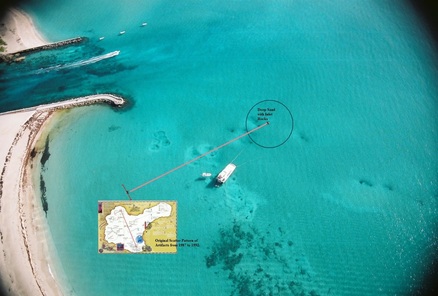
In 1987, two surfers fell off their boards one day and saw what they thought was a cannon and reported it to a lifeguard. Two days later, while on his morning training swim, the lifeguard refound the cannon and contacted a master mariner and marina owner, Captain Dominic Addario, who had equipment capable of recovering the find. They agreed to form a joint venture to recover it.
They resolved to put the cannon at a museum about to open in Burt Reynolds Park, sponsored by the Loxahatchee Historical Society. During those first weeks, further discoveries were made. More cannons were identified, then silver “pieces of eight.”
Neither of the two partners knew at the time that the laws governing discoveries such as theirs were approaching a major change, or that the two of them could play an instrumental part in the formulation of new rules that would affect the future rights of the private sector to participate in historic shipwreck research and recovery.
Captain Addario placed an Admiralty claim upon the unknown vessel in the U.S. A bond was posted to the Court, and Jupiter Wreck, Inc., a newly formed Florida corporation, was subsequently named Federal Substitute Custodian of the wreck site.
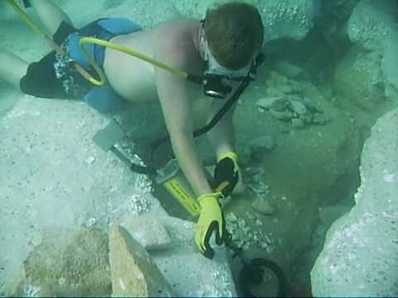
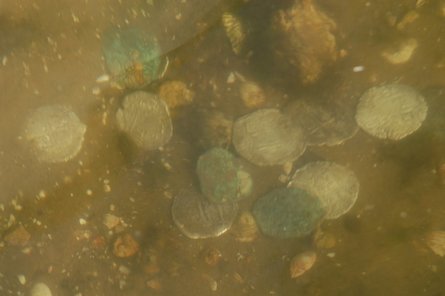
More cannons and artifacts were discovered. Rare coins of silver and gold were retrieved, then a 78-pound ingot of silver!
The State of Florida stepped in to assume jurisdiction, claiming it was in the wreck's and public's best interest. The public didn't totally agree, neither did the Federal Courts. Jupiter Wreck's legitimate claim was upheld by the Federal Judge, but the State's rights were also recognized. The crew had to dig with their bare hands while all issues were pondered.
Historical Research
Based on documents from the Archivo General de Indias in Seville, Spain, researcher Victoria Stapells Johnson identified that the starting point in the Spanish archives was the section Contratación (issues related to trade with the Indies) and specifically the Libros de Registros for the mid-17th century. Silver and gold coins and particularly a silver bar marked no. 820 found at the site indicate a point of departure from Tierra Firme, the ports of Cartagena and Portobelo.
Of the ships which meet the profile for the Jupiter Wreck, six are aviso ships. By decree of the crown in 1525, avisos were designated to carry official correspondence between Spain and her overseas colonies. Two courier ships were dispatched each year from Spain to Nueva España (Mexico) and Tierra Firme (north coast of South America). Small ships which generally did not exceed 100 toneladas, these vessels were capable of sailing quickly and efficiently.
On the return trip, one can imagine that a certain amount of contraband was loaded on these ships in the form of silver or gold. This was common practice on all ships during the colonial time period. In the time frame of the Jupiter wreck, there were four ships which sailed as avisos and appear to have wrecked on their return trip to Spain from Tierra Firme ports.
One candidate is the San Francisco y San Antonio. In 1657, Bernardo Somoza requested that his ship of 60 toneladas cargo capacity, built in Seville, be granted a license to sail to Tierra Firme as an aviso. This aviso left Seville in February 1658 for the ports of Cartagena and Portobelo. There is no evidence that it returned.
Shop Authentic Treasure
Explore our collection of authentic shipwreck coins: gold and silver treasure recovered from legendary Spanish galleons.
Browse Shipwreck Coins